
Report from Tunisia – a bitter reality, a challenge
By Ben Zid Touhami
Workers World received the following report Oct. 22 in a letter from a friend in Tunisia, Ben Zid Touhami. WW publishes it in English translated from Arabic by Deepl with the result slightly edited.
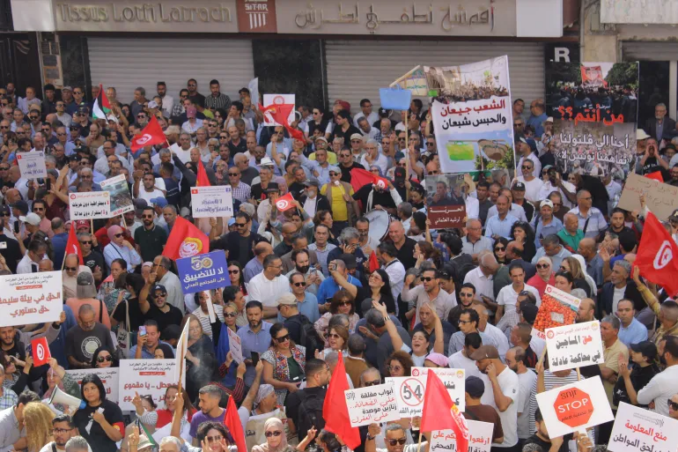
Tunisians protest against sitting government, Tunis, Oct. 17, 2026.
Tunisia occupies a very important strategic location in North Africa.
Tunisia serves as a gateway to both Africa and Europe, boasting a mild Mediterranean climate, fertile land and significant agricultural diversity. It is rich in resources, but unfortunately, it is not self-sufficient in grains and food in general due to haphazard agricultural policies; thousands of hectares lie neglected, uncultivated and barren.
Tunisia is Africa’s leading exporter of olive oil, and its oil is of high quality. However, economic and political dependence forces it to export most of its olive oil production to the European Union, where its olive oil exports must arrive unpackaged, particularly for France, Spain and especially Italy. There, Tunisian oil is packaged after being blended with Italian oil, and the product bears the names of Italian and Spanish companies that capitalize on Tunisian oil’s high quality.
In addition to its abundant production of vegetables, grains and legumes, Tunisia produces very substantial quantities of the finest varieties of dates. It exports, in particular, the “Dagla al-Nour,” which is unique in the world.
Nevertheless, Tunisian citizens are deprived of the bounty of their land due to exorbitant prices, skyrocketing costs and the erosion of the purchasing power of the general Tunisian population.
Tunisia also produces phosphate and its derivatives; it is the second-largest exporter after Morocco. Tunisia’s salt production is virtually monopolized by French companies which pay next to nothing under colonial agreements. Thus, the exploitation of Tunisian salt is carried out almost exclusively and free of charge to French companies.
Tunisia is also distinguished, thanks to its location, climate and cultural history, by a unique tourism offering.
Tunisia is further distinguished by the awareness, culture and educational attainment of its youth. Tunisian professionals — including doctors, engineers, teachers and specialists in technology and communications — are in demand worldwide.
Life for Tunisian youth is unstable
At first glance, one might think that Tunisians enjoy a comfortable and stable life, but the reality is quite the opposite. Young university graduates and degree holders suffer from unemployment, marginalization and a lack of prospects. This situation drives a large segment of the youth toward addiction, drug use and illegal migration.

Unemployed Tunisian graduates demand jobs, Tunis, Oct. 17, 2026.
Tunisian youth, especially university graduates, are waging a daily struggle for employment and dignity, led by their organization, the Union of Unemployed Graduates (UDC).
However, instead of engaging with them, listening to their demands and seeking solutions to their concerns, the ruling authorities employ a policy of stalling, procrastination, repression and harassment. Recently, the youths’ sit-ins and demonstrations have been forcibly dispersed. The situation has even escalated to the point of expelling them from the capital, Tunis — a dangerous precedent that undermines freedom of movement and human rights.
Nevertheless, young people continue their activism with determination and great commitment, and they have achieved numerous partial victories — perhaps the most notable of which is Law No. 18 of 2025 on the employment of the long-term unemployed. Today, those with degrees are fighting for the activation and implementation of this law.
The same is true of the environmental movement against pollution in the governorate of Gabès, which until recently was a lush oasis — a pleasant place to live, with towering palm trees and high-quality, valuable dates. However, since the establishment of the chemical complex — affiliated with the public enterprise Phosphate of Gafsa — residents have been suffering greatly due to air pollution from the complex’s emissions and the dumping of phosphogypsum residues and sediments into the sea (Shatt al-Salam), even though the complex’s headquarters is located in Tunis!
Last year there were numerous cases of suffocation among schoolchildren, students and the general public, in addition to cases of chronic diseases, particularly cancer. The residents of the Gabès Governorate have reaped nothing but chronic diseases, unemployment, marginalization and poverty.
Gabès’ residents refuse to give up
But the residents have not given up. Instead, they demand the closure of the complex and the dismantling of its facilities. The local population organized numerous marches, with more than 100,000 demonstrators, only to be met by the authorities with tear gas, beatings and arrests — which even extended to the royal palace. The participating activists were tried and sentenced to harsh penalties on trumped-up charges.
The same repression applies to activists supporting Palestine and condemning the war of extermination and starvation against Gaza.
Young people managed to hold numerous seminars in support of Palestine and its people and carried out a series of actions, demonstrations and vigils in front of the French and American embassies. Perhaps the most notable achievement of our youth in their efforts to support Palestine and lift the siege on Gaza was, first, they successfully organized a Maghreb land convoy comprising thousands of participants, which was blocked by Haftar’s forces in Libya before it reached the Rafah border crossing between Egypt and Gaza.
The youth continued to diversify their actions, ranging from boycotts to organizing and participating in the Global Flotilla of Solidarity to break the siege on Gaza. The flotilla set sail with more than 50 boats and ships from the marina in the Sidi Bou Said suburb.
We all know how the Zionist enemy treated the activists participating in international waters and how it took all participants into Zionist territory and held them in detention for days, and the world witnessed how the fascist Ben Gvir bullied them.
The same is true of the suffering of female farmworkers, as we have documented numerous fatal incidents in which many of them lost their lives under working and transportation conditions that can only be described as inhumane and degrading to human dignity and personhood.
In addition, the judiciary, the press and the media have been co-opted, with many journalists and bloggers languishing in prisons simply for a blog post, a newspaper article or merely expressing an opinion on a radio or television program.
Pro-Palestine activists jailed
The leaders of the “Flotilla of Steadfastness” remain in the regime’s detention centers and prisons to this day, having been held for months on end, despite the ruling authority’s lip service claiming support for the Palestinian cause.
This stands in stark contrast to the daily hardships faced by Tunisian citizens: the deterioration of transportation, education and health services; the scarcity of basic goods and medicines — some of which have been unavailable for months — as well as soaring prices. These conditions have driven Tunisians to organize numerous protests and demonstrations, which the authorities consistently meet with procrastination, smear campaigns and repression.
Unfortunately, the rise of political Islam (the Ennahda Movement) to power in 2011, followed by the opportunistic alliance between political Islam and the pro-Morsi Constitution Party — Ennahda/Nidaa — paved the way and opened the door to the counterrevolution, the consequences of which we are experiencing today, especially since the balance of power is skewed and leftist and communist parties and organizations are weak and fragmented.