
Black Panther Party: A 60 year-old legacy
WW commentary
Sixty years ago, after examining conditions in Oakland, California, Huey Newton and Bobby Seale, along with other Black youth, founded the Black Panther Party in Oakland, California. They looked most closely at the Oakland Police Department’s occupation and terrorism.
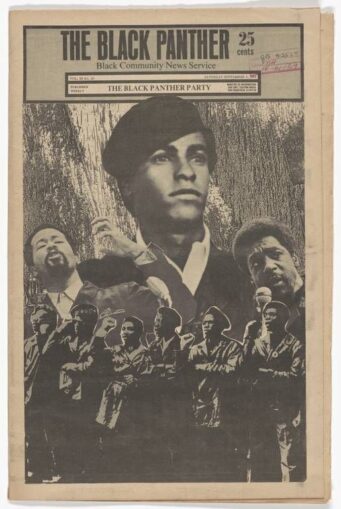
For years the department had served as the vicious arm of the ruling class, doing nothing less than brutalizing the Black community. Due to these material conditions, Newton and Seale formed the Black Panther Party for Self-Defense on Oct, 15, 1966, to combat the state terror used against the Black community.
Armed patrols and self-defense were nothing new in the community, contrary to the position pushed by bourgeois historians. Historians have often promoted the myth and stereotype that the Black working class was defenseless against the violence of the white supremacist power structure. That they needed the help of heroic whites to fight back.
That myth is not only false but also revisionist and reactionary because these historians purposefully leave out how, from the time of being kidnapped from Africa to the present day, Black people have always practiced self-defense. This tradition spans centuries and goes back to Africa, where different groups and kingdoms formed armed patrols to resist slave-trading parties.
A history of resistance
Examples include Queen Nzinga Mbande of the Ndongo Kingdom in modern-day Angola, who formed patrols with her people to defend against the Portuguese enslavers. Another is the Kingdom of Niumi, whose people lived close to the Gambia River. Knowing how important the river was to Europeans for kidnapping Africans into the slave trade, they restricted it and kept armed patrols on the water to deal with any slave ships that tried to use it.
This tradition continued when enslaved people were brought to the United States and the West Indies, with many Maroon communities using self-defense to resist slavery. It continued through generations, from the end of enslavement into the Reconstruction era, which saw it on full display in the actions of Captain Jim Willams and the York County Militia of South Carolina.
This militia and other groups like the Union League helped organize against the Ku Klux Klan, which was extremely active in York County and throughout South Carolina. Even during the Jim Crow era, this policy of self-defense was never abandoned.
A famous account comes from the great revolutionary Queen Mother Moore, who recounted organizing self-defense for the UNIA (Universal Negro Improvement Association) – ACL (African Communities League) in the 1920s in her birth state of Louisiana. She described how the Black comrades of Louisiana were far from helpless,with many, including herself, organizing defenses for organizational events.
It was because of this revolutionary Black radical tradition that the Black Panther Party would emerge for the entire country to see when, on May 2, 1967, dozens of them defiantly stood on the steps of the California State Capitol in Sacramento with guns to make the point that they had a legal right to bear arms to protect themselves from the repressive state, especially the police. This act electrified the Black community and the movement.
The Party began to organize the people and give a clear analysis of the conditions that affect Black people. Using dialectical materialism to understand the conditions the Black proletariat is subjected to, they wrote and published the BPP’s Ten Point Program. It was written plainly to break down demands for comrades in the Black community.

They wrote plainly because, as Bobby Seale explained: “We’re going to draw up a basic platform, just basic so Black people can read. We don’t want to go real elaborate on essays or dissertations or all of this stuff, cause the brother’s gonna look and say, ‘Man, I got time for that? I gotta go see what I can do for myself.’”
The point Seale and Newton, along with others in the Party, were getting at was that they recognized the people are not uneducated, but simply did not have the time to go into the weeds of dialectical materialism or the academia behind it. To do that would mean losing the people, so they broke it down into simple points, just as Mao Zedong did in the Little Red Book.
The Black Panther Party was able to do this not only for the Black proletariat but also for the proletariat in general, as shown by organizations such as the Brown Berets, the Young Lords, the White Panther Party and the Young Patriots, among others. This, in addition to the survival programs, is also why the Panthers earned the nickname “the Vanguard of Revolution.”
All of this tears apart the image the bourgeois media still portrays to this day of the Panthers as a bunch of gun-toting radicals with no revolutionary discipline, running wild and causing the violence that forced law enforcement to act. That is false, as the historical record shows how often Panthers were mainly unarmed when police murdered them.
An example is Fred Hampton, Deputy Chairman of the Illinois chapter. On Dec. 4, 1969, he and Deputy Minister of Defense Mark Clark of Peoria were murdered by the Chicago Police Department (CPD). An investigation the Black Panther Party and people in the community carried out helped debunk the narrative the police and media tried to push that Hampton and the Panthers inside his home attempted to assault and murder the police sent to kill him — police who in reality were a death squad.
The investigation showed that all but one of the hundreds of bullets fired came from the police. That single bullet came from Mark Clark, the only member in the house who was armed, who accidentally fired his gun into the ceiling as he was dying after being fatally shot by a CPD officer. Fred Hampton, meanwhile, was incapacitated during the assault, and was completely defenseless and unarmed when police shot him multiple times while he was asleep.
Need for revolutionary theory
The Party was also strict about discipline, especially when carrying out the will of the people and organizing in the community. As Fred Hampton stated in a 1969 interview, members had to meet explicit requirements before being fully accepted. These included reading the party’s Ten Point Program and understanding what it was about.
They also had to read “The Wretched of the Earth,” by Frantz Fanon, “The Autobiography of Malcolm X.” and “Black Reconstruction,” by W.E.B. Du Bois. Members were also required to attend political education classes, and BPP leadership made sure to stress why attendance mattered.
In her autobiography “A Taste of Power,” Elaine Brown, who became the first woman to head the Party, famously recalled: “We would have to attend political education classes regularly and read certain books. There was a long list of intraparty disciplinary rules.”
Brown also described how members were expected not only to learn about firearms but also to learn emergency medical techniques, to know how to do Party work such as the free breakfast program, and even to handle basic tasks such as passing out the Panther newspaper.
Furthermore, it was not the fact that the Panthers had armed patrols or were armed that led the ruling class to respond with repression. It was the survival programs and the party’s ability to organize at a fast rate. This is clear from J. Edgar Hoover, who stated that the job and responsibility of the infamous COINTELPRO was to “prevent the rise of a messiah who could unify and electrify the militant Black nationalist movement.”
As Marxists, we recognize through dialectical analysis that no one person or one organization could do such a thing. Due to its revolutionary program relevant to the Black community at home and the anti-imperialist struggles abroad, these are important reasons why Hoover called the party the greatest threat to the internal security of the United States. It was also the reason the state engaged in a completely illegal campaign to oppress, murder and carry out terrorism against the Party, leading to its demise by 1981.
People may wonder now what we can make of the Black Panther Party 60 years later? What can we make of the revolutionary movement among Black people today? The answer is that the struggle did not die with the Black Panther Party, even though many of its revolutionaries were killed and imprisoned. The struggle continues, and the Panthers serve as a revolutionary symbol of what organizing and education can do for the people.
An example is that the ruling class attempted to replicate a free breakfast program similar to ones the Panthers ran in all of their chapters to feed thousands of Black children who were not being protected by the government at the time, and then later put it on the chopping block. Government-sponsored free lunch programs are now being threatened by drastic cutbacks. This goes to show that the Panthers’ organizing forced the state to give this small crumb, a temporary concession, to the people.
Demands still relevant today
The Ten Point Program, the core of the Party’s organizing and its analysis of the conditions of Black people in the belly of this reactionary beast, is still relevant today.
Take the case of Karmelo Anthony, who was sentenced by an all-white jury to 30 years in prison for simply defending himself. What makes his case relevant is Point 9, which says, “We want all Black people when brought to trial to be tried in court by a jury of their peer group or people from their Black communities.”
This matters because there were no Black people or people of color on the jury during Anthony’s trial, and the county where the case took place would very much have declared him guilty without even looking at the evidence.
Another point that speaks volumes today is Point 7, which says, “We want an immediate end to police brutality and murder of Black people.” This is more relevant than ever, given the surge in police murders and especially the coverups and the ignoring of the murders and lynchings of Black youth.
The most notable recent case is that of Nolan Wells. There is also Athoneil Williams II, who was shot over 22 times by Austin, Texas, police, who were quick to justify their actions by saying he committed so-called “suicide by police.” No action has been taken against the officers who murdered him.
Then there was the murder of one-year-old Kohen Wiley in Mississippi, where police riddled the car he and his mother were in with bullets, on the account that she had allegedly stolen diapers from a store, which she hadn’t. These are among so many other murders committed by the armed wing of the state.
What makes it even more poignant is that the youngest leader of the Black Panther Party, Bobby Hutton, who was himself murdered by the Oakland Police Department, was 17 when he was killed, the same age as Athoneil Williams II.
As stated before, the ruling class recognizes the potential in the revolutionizing of Black youth. Especially now, with the constant occupation and terrorism committed against the Black community, many youth have become radicalized and revolutionized and have taken to organizing, which is the same condition that caused the formation of the Black Panther Party in the first place.
How to remember the Black Panther Party?
As revolutionaries, we recognize that we must learn from the history of the Black Panther Party and celebrate its revolutionary achievements.
We must also learn from the Party’s efforts to take care of the people through free breakfast programs, free health clinics, and its many other survival programs, and be more involved in helping organize the people, not only because we want an end to this murderous capitalist system, but out of love for the people.
In the words of Fred Hampton, “It is criminal to think you’re better than the people.”
We must continue to stress and support the self-determination of the Black proletariat to decide what happens in their own community. And we must continue to organize and educate, because we sometimes catch ourselves believing the lies of the media and this system that the Panthers were successful because they had guns. The reality is that the Panthers preached and defended the right to self-defense.
Only by doing these things can we honor the legacy that the Panthers and many other revolutionary organizations and movements strived for. By learning from them, we can eventually establish a dictatorship of the proletariat and a revolutionary people’s government.