Native Americans drive mining company off sacred land
Nine Native American tribes, joined by local community activists, successfully drove off a mining company on May 8, preventing them from drilling on their sacred ceremonial land in the Black Hills of South Dakota. This is part of a larger Indigenous Land Back movement growing in the U.S., which includes local direct action and legal victories.
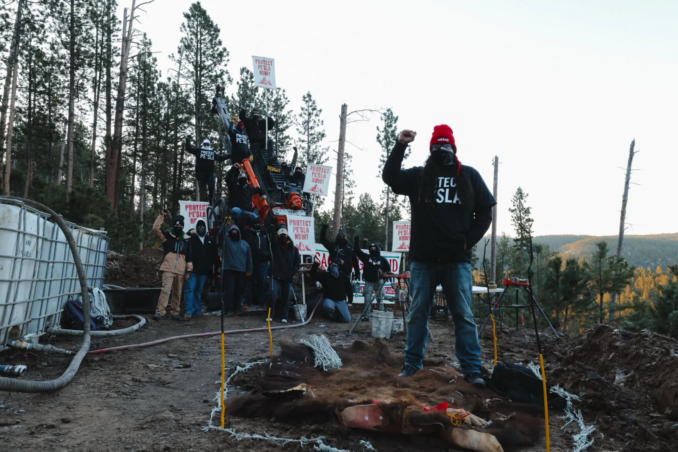
Community members defended the land near sacred Lakota site Pe’ Sla, where exploratory drilling has begun in the Black Hills around South Dakota, on April 30, 2026. Photo: Angel White Eyes
The Black Hills site is part of a high mountain prairie called Pe’ Sla, meaning “heart of everything that is,” and is owned by tribes of the Očhéthi Šakówiŋ, also known as the Great Sioux Nation. It is an important spiritual, cultural and historical place for the Lakota, Dakota and Nakota nations. Native American tribes find plants for food and medicine there, such as the timpsula, a prairie turnip high in calcium.
It’s home to herds of buffalo and a source of clean water. Drilling near Pe’ Sla could contaminate drinking water in surrounding communities. In late April, two Oglala Lakota scouts said they followed a red-tailed hawk to freshly cut dirt roads that led them to a mining operation engaged in exploratory drilling.
Despite great opposition, the U.S. Forest Service had quietly granted the mining company 18 exploratory drilling sites in early April. Native American tribes and community groups had filed several federal lawsuits against the Forest Service and the Department of Agriculture for lack of consultation with tribes and for inadequate environmental reviews required to drill near Indigenous land.
The company, ignoring suits, began drilling around the clock to complete as much as possible before the court hearing.
The success of collective organizing
Immediately about 40 activists arrived, including from Indigenous and community environmental organizations, and an advocacy group NDN Collective. They blocked the road and occupied two of the company’s drilling pads.
The plan was to have a one-day action, but the occupation lasted seven days, with people camping out in 10 degree nights. Because of a drought, they couldn’t build fires for fear of causing a wildfire. The Youth Council remained closest to the mining machinery, while the elders anchored the camp. During the trial, more than a hundred students marched out of high school to join protesters at the federal courthouse in Rapid City, South Dakota.
On May 4, the judge granted a 14-day pause of mining operations, but, because of the intense controversy, the company packed up and left on May 7. Wizipan Little Elk Garriott, president of NDN Collective and a former Interior Department official, said: “I think it shows the power of organizing, the power of community coming together to say ‘no’ through direct action. It also shows the power of being able to bring things to the court. And then it also shows the power of tribes being able to organize and to take action.” (Truthout, May 2026)
The power of Indigenous land protectors
An Indigenous Land Back movement is growing in the U.S., including grassroots direct action and legal victories. The South Dakota mining company was looking for graphite, a critical mineral in electric car batteries. However, once a company has the right to drill, it can look for whatever else is in the earth. More than 75% of the lithium, copper and nickel in the U.S. is found within 35 miles of an Indigenous reservation. There is a soaring demand for these metals, which are components of green energy batteries and solar panels.
Globally, Indigenous people make up only 5% of the world’s population, but they care for one quarter of earth’s surface. (tinyurl.com/yc6ufyyp) There are a growing number of Indigenous land protectors (land defenders, water protectors, or Indigenous Guardians). They safeguard ancestral territories, ecosystems and natural resources from exploitation.
Nearly 80% of the planet’s remaining biodiversity exists on land managed by Indigenous communities. There is less deforestation on Indigenous land than in the rest of the world. Using traditional land management practices, such as controlled burns, rotational harvesting and waterway caretaking, Indigenous lands have higher rates of carbon storage and ecological health than government-managed areas.
Several Očhéthi Šakówiŋ tribes purchased Pe’ Sla for $9 million in 2012. An increasing number of Indigenous tribes and organizations are reclaiming ancestral lands around the continent through purchases, land donations and partnerships with state and federal conservation agencies.