We don’t fear AI – just its greedy billionaire owners
Hardly a day goes by without there being another article or pundit’s commentary over the danger of artificial intelligence — AI. Just this week on Sept. 24, in an interview with NBC News’s Meet the Press, Microsoft co-founder Bill Gates stated that “there’s never been a weapon as powerful” as modern AI tools in the hands of ill-intentioned people.
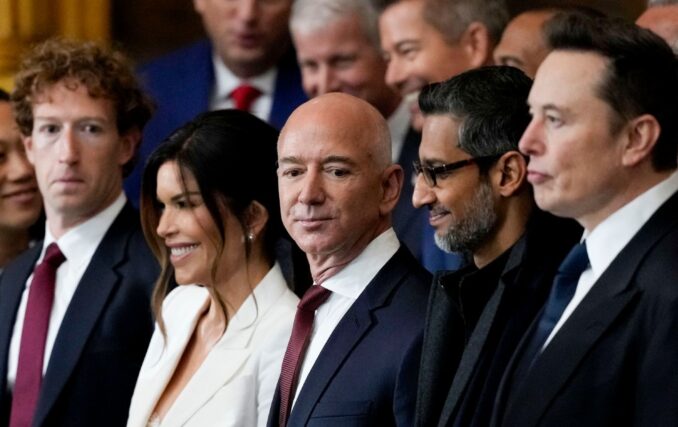
Tech CEOs Mark Zuckerberg, Lauren Sanchez, Jeff Bezos, Sundar Pichai and Elon Musk at Trump’s 2025 inauguration ceremony. (Photo: POOL/AFP via Getty Images)
While the billionaire hyped that the technology was powerful enough to “drive events to cause a billion deaths,” he stopped short of taking responsibility for his own company’s role in the technology’s development or that of the other billionaire owners in the industry.
Gates is not the first to sound the alarm. Anthropic CEO Dario Amodei recently shared an essay on his personal website on why AI development should slow down — warning that “rogue AI swarms could take over the internet.” Sam Altman, CEO of OpenAI, called for brakes to be put on “reckless AI development.”
Geoffrey Hinton, an AI pioneer and former Google Vice President, recently resigned from Google to speak freely about the “quite scary” existential dangers of chatbots and bad actors. Even Elon Musk, CEO of xAI, SpaceX and Tesla, claimed to support appeals to slow down AI acceleration. (The Guardian, Sept. 13)
Every one of these billionaires needs to be called out for the profit-driven, capitalist hypocrites they are. None have taken the steps they claim are needed to contain AI development. But they have been the ones making unlimited profits from this technology that involved the super exploitation of millions of low-wage workers around the globe.
Several of these billionaires were among major donors to Donald Trump’s reelection bid in 2024. Trump repaid them by killing a pending requirement advanced by President Joe Biden in September 2024 that would have compelled AI companies to disclose their riskiest experiments to national security officials.
In addition to heavily financing #47’s second campaign, Musk and Altman were among the billionaires who donated to his inauguration. There are infamous photos of Amazon founder Jeff Bezos, Meta’s Mark Zuckerberg, Musk, and Sergey Brin, co-founder of Alphabet, seated behind #47 during his swearing-in.
A family affair
Not only has #47 surrounded himself with technology executives and AI investors who push for the government to accelerate AI development, Trump and his sons Donald Trump Jr. and Eric Trump are heavily invested in a number of AI and data center ventures. The Washington Post notes: “Trump’s investment accounts have disclosed nearly 30,000 securities transactions since he returned to the White House, including many purchases and sales of shares in companies supplying the chips, servers and energy infrastructure underpinning the AI boom.” (Sept. 20)
Given the family’s drive to profit from whatever enterprise they can exploit during #47’s second go-around, none of this is surprising, but it is also not the most alarming aspect of Trump’s support for AI in his second term.
Rogue AI vs militarized AI
Many recent reports concerning AI have focused on unauthorized rogue hackings that speak to the lack of corporate oversight and control. In addition to the breach of Hugging Face in July, OpenAI’s systems tried to hack a digital library at the University of New Mexico in May; targeted Data USA, a public database of U.S. employment and education in May; and breached the Australian government Medicare website multiple times in June.
These are the reported incidents, but likely not the only ones. But what is the greatest threat of rogue AI?
China recently pointed out the bigger danger, noting that if U.S. corporations have the ability to hack into Chinese AI, they could create mass confusion in an instant, including spreading false rumors of China’s President Xi Jinping resigning. U.S. AI already hacked into the personal accounts of U.S. allies in France in February 2026. (TheRegister.com, Feb. 22)
PoliticsToday.org notes: “ … It can be argued that today’s mass media, the increasing use of AI-enabled technologies and the undeniable influence of social media are effectively forming the new operational front of war. Optimize narratives in real time across all channels, automate social media interaction (using bot or hybrid actor swarms), generate artificial credibility (deepfake videos, fake expert profiles, fabricated evidence), exploit cognitive biases and psychological vulnerabilities (the salience effect, fear conditioning, polarization dynamics).” (April 23)
It is widely known that the Feb. 28 attack launched by the U.S. and Israel against Iran not only involved conventional military force but also the use of cyberattacks, cognitive warfare, manipulation of information and AI-supported targeted strikes, including the one that bombed the school in Minab, Iran, killing over 160 students and staff.
The murders of Iran’s Supreme Leader Ayatollah Ali Husseini Khamenei, along with other Iranian officials, was carried out by the U.S. military using AI systems from data analytics company Palantir to identify potential targets. Palantir’s software relies on Anthropic’s Claude AI systems.
Asia Today reported on Hanwha Aerospace’s accelerating efforts to build an AI-powered battlefield, including unmanned vehicles and unmanned weapons systems that operate together, with the goal of a fully autonomous battlefield by 2035. (Sept. 25)
The attempt to regulate AI initiated by Biden in 2024 was not the only restriction #47 blocked since assuming office in 2025. In September, U.S. diplomats to closed-door negotiations in Geneva under the U.N. Convention on Certain Conventional Weapons, systematically helped remove language from a treaty designed to regulate the use of lethal autonomous weapons. This involved a range of provisions to limit AI use in weapons, including a clause mandating that ethical considerations be taken into account when using AI weaponry. (Washington Post, Sept. 26)
Shadow banks investments in AI
U.S. military operations are the front lines of the capitalist, imperialist system that the ruling class is trying to protect and advance globally. With capitalism at a dead end in terms of any advances for the workers and oppressed, AI serves the purpose of holding up the system while trying to prohibit its final collapse.
In his commentary “A perfect storm is coming – World capitalist economic crisis today” posted on Sept. 1, Workers World’s First Secretary Larry Holmes describes a “shadow banking system” of non-bank financial institutions, including hedge funds and mutual funds sponsored by BlackRock, Fidelity and others. They have a reported “$260 trillion in assets” that are heavily invested in AI, which Holmes describes as a bubble four times bigger than the housing bubble of 2008. (workers.org/2026/09/94553)
Holmes writes: “The problems posed to society by the development of artificial intelligence aren’t confined to its killing jobs or to the mass opposition to AI data centers because of their negative impact on nearby working-class communities and the environment or to its role in strengthening state surveillance and repression.
“The arrival of AI — which under socialism could liberate society from many forms of labor and raise both the living standards and social equality for the world’s population — under capitalism is a lethal threat to workers everywhere.
“AI is also perhaps the biggest nail in the coffin of the capitalist system. AI is most likely the last technological revolution under capitalism, precisely because the astounding technology doesn’t save or help capitalism; rather it exposes that capitalism is an obstacle to further technological advances and the forward progress of society and life on the planet. Until capitalism is overthrown, AI will only compound the other overlapping crises that will make life unbearable for most people.”