The death penalty: 50 years after reinstatement
Texas has just gone four whole months, 125 days, without carrying out an execution. The Earth is still spinning on its axis and orbiting around the sun. The Texas governor is still opposed to same-sex marriage and abortion and wants the Ten Commandments displayed everywhere. These 125 days prove Texas can survive without any state-sponsored executions.
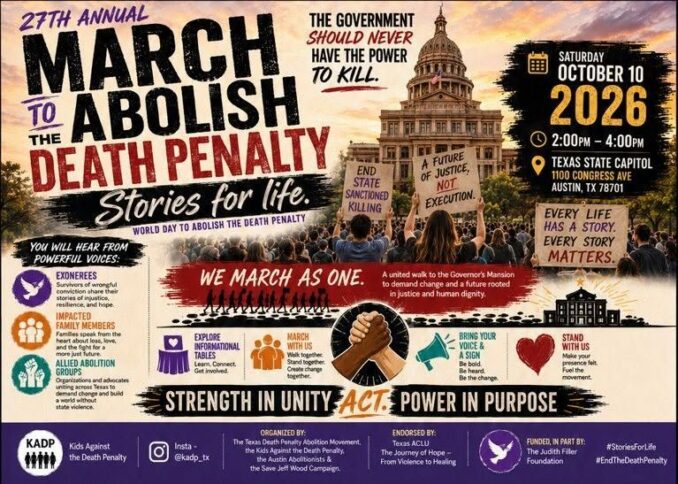
But, on Sept. 16, executions will resume when LeJames Norman, a 40-year-old Black man and father of three, is scheduled to be legally lynched in Huntsville at 6:00 p.m. Norman’s life was troubled from the beginning, as his father physically assaulted his mother when she was pregnant with him. Norman’s family was extremely poor and lived in several homeless shelters. His parents fought constantly, suffered from drug and alcohol use and abused Norman physically.
A police officer fatally shot his father causing Norman to have chronic nightmares. Norman attended special education classes. Like too many youth of color, this racist system allowed him to fall through the cracks.
One week after Norman’s scheduled execution, his partner is also set to die. Ker’Sean Olajuwa Ramey, also Black, was not the shooter in the incident these two men were charged with. He was there, however, and was determined to be guilty of capital murder under Texas’ infamous Law Of Parties.
Many constitutional violations led to Ramey’s conviction and death sentence. These include the systematic exclusion of all potential Black jurors, the state’s presentation of false testimony and, above all, the abysmal performance of his trial attorney, who failed to conduct his own investigation or provide witnesses to rebut the state’s case.
Crucially, trial counsel failed to present readily available mitigating evidence of Ramey’s childhood abuse, poverty and cognitive impairment during the penalty phase of the trial. This evidence could have persuaded jurors to spare his life, but instead — without any such details about his background — they deliberated for only 14 minutes before sentencing Ramey to death.
The U.S. has 29 more executions scheduled for this year.
A history of legalized white supremacy
This past July marked 50 years since capital punishment was reinstated by the U.S. Supreme Court’s landmark ruling in the case of Gregg v. Georgia in 1976. This began what is now called the modern era of the death penalty.
Supposedly, new legal guidelines in sentencing procedures were going to ensure fairness and consistency, but after 50 years, statistics prove this has not happened.
After almost 1,700 executions in the last half century, the facts are clear:
- The death penalty is still racist.
- People of color are 58% of those sentenced to death, but only 38% of the population.
- Legal errors are still common; 203 innocent people have been exonerated off death row with over 100 being African American.
- Arbitrariness continues. A death sentence still depends on the county where the crime occurred rather than on the nature of the crime itself.
In recent years, abolition activists view changes to the death penalty as unfair and unconstitutional. Non-unanimous juries are sending people to death row in Florida and Alabama; this includes almost 60% of those on Florida’s death row. Ironically, Florida leads the country with 30 innocent people having been exonerated from death row since 1973. (Death Penalty Information Center)
Since the decade beginning with 2010, pharmaceutical companies have refused to supply drugs for lethal injection executions after a successful campaign by activists in Europe.
Nitrogen hypoxia, which is not even allowed to euthanize animals, has tortured people to death in Alabama and Louisiana. According to the Equal Justice Initiative, “Risks include feelings of suffocation and choking to death on one’s own vomit, as well as brain damage, a stroke or a persistent vegetative state instead of death.” (eji.org/)
Since this gas is odorless and colorless, guards, other prison staff and witnesses including news media, face a risk of asphyxiation if there is a leak of the gas.
Electrocution, firing squads and gas chambers are now options in many states. Because the Supreme Court has never found any method of execution unconstitutional, all known methods can be used if lethal injection drugs cannot be accessed.
Organize and fight!
Nationally, recognized civil rights and legal organizations and a law firm filed a writ petition in the California State Supreme Court challenging the state’s death penalty statute as racially discriminatory and unconstitutional under the Equal Protection guarantees of the State Constitution. This is the first time a petition of this nature has been filed w ith the court.
There is positive news from the Death Penalty Information Center:
- More than half of young U.S. adults aged 18 through 43 now oppose the death penalty.
- Opposition to the death penalty has nearly tripled over the past three decades.
- Support for the death penalty is at a five-decade low.
During the first six months of 2026, the Death Penalty Information Center documented new efforts to conceal critical details about the death penalty. The reality about the death penalty and executions is seen as a threat to public support for executions by its proponents.
U.S. Supreme Court Justice Thurgood Marshall, the first African American to ever sit on the bench, understood this 50 years ago. His dissent on the vote to reinstate capital punishment said, “The American people know little about the death penalty, and the opinions of an informed public would differ significantly from those of a public unaware of the consequences and effects of the death penalty.” (naacp.org)
Opponents of legal lynchings continue to educate their coworkers, congregants in their houses of worship and students on their campuses. With death row exonerees speaking out, their stories change hearts and minds. Families of murder victims who oppose capital punishment play an important role in abolition. When statistics about innocence, torture and racism see the light of day, support for executions will continue to diminish. Total abolition is the light at the end of the tunnel.
The phrase “better to be rich and guilty than poor and innocent” was made famous by Bryan Stevenson, founder and executive director of the Equal Justice Initiative. Activists must continue to organize and fight until this quote is no longer relevant!
The writer is a founding member of the Texas Death Penalty Abolition Movement.