Gary, Indiana and a tradition of neglect
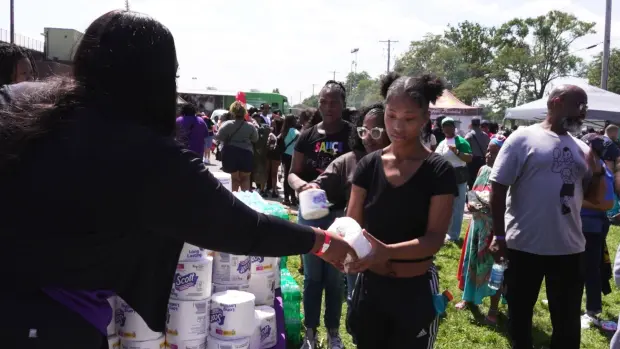
Aid for Black families in Gary, Indiana, during power outage.
The situation in Gary, Indiana, has caught the attention of the entire country. From Aug. 11 to Aug. 26, Gary had no power, gas or food because of a storm that knocked out power in the city. And some residents still don’t have these essentials back on. What happened in Gary wasn’t some random tragedy. It’s a systemic continuation of the ruling class ignoring the effects of capitalism on the working class, including the Black community.
When it comes to catastrophes like this one, the state’s response to Black workers has always been the same: an official policy of racist neglect. That’s the ruling class’s position, because they believe that Black lives, and their material conditions capitalism itself creates, simply aren’t their problem. This has been a longstanding, historical policy.
Gary is not the first time something like this has happened. In 1893, a hurricane hit the Sea Islands of Georgia and South Carolina, home to a majority Black population rooted deeply in the Black radical tradition. These islands saw Maroon communities form as a means of resisting enslavement, followed by the first revolutionary sparks of Reconstruction, when newly freed Black people began occupying the land they had once been enslaved on.
In the aftermath of Special Field Order 15, which promised formerly enslaved people 40 acres and a mule, freed people on these islands, most famously on Saint Catherine’s Island, took advantage of that promise. That is, until pro-Confederate Andrew Johnson’s federal administration ordered the land returned to the former planter class, evicting 40,000 Black people from the homes and the new lives they had organized to build.
When the 1893 hurricane hit, the state refused to act. Governors Ben Tillman of South Carolina and William Northern of Georgia, along with their racist legislatures, flatly refused to help the Black community to recover on the islands. The federal government backed that refusal by declining to intervene as well.
Thirty-four years later, the same reactionary policy held strong during the 1927 Great Mississippi Flood. Close to 500 people died, and 640,000 to 700,000 were displaced, the majority of them Black, with communities across Mississippi, Louisiana and Arkansas hit hardest. Once again, the pattern repeated itself. The National Guard served as an armed extension of Jim Crow, infamously forcing Black families to stay in the floodwaters while white families were spared that kind of treatment by evacuation.
In eastern Arkansas, both the sheriff’s department and the National Guard kidnapped Black people and forced them into labor, even though most of the farmland was already underwater, all to keep profits flowing, the norm under capitalism.
In Louisiana, the deliberate dynamiting of the levees in 1927 destroyed entire Black communities and parishes. Segregation continued even during disaster relief. Black flood victims were forced into segregated Red Cross camps and at times, denied aid altogether.
Throughout all of it, the U.S. government maintained its policy of non- involvement, even refusing to respond to reports of white supremacist violence and terror taking place.
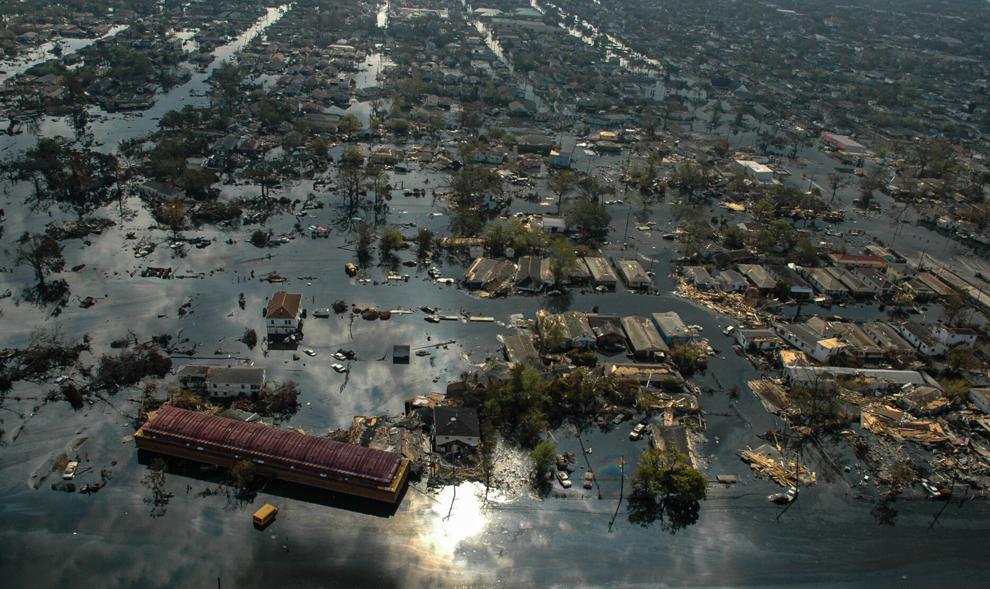
Ninth Ward flooded during Hurricane Katrina, 2005.
Hurricane Katrina: History repeats itself
Seventy-eight years later, it happened again. Hurricane Katrina destroyed half of New Orleans in August 2005, and the state of Louisiana doubled down on the same stance toward the city’s Black community. The armed wing of the state was on full display when the New Orleans Police Department killed unarmed 17-year-old James Brissette and 40-year-old Ronald Madison, a mentally disabled man, after opening fire on members of the Bartholomew family.
Officers then planted a firearm at the scene and claimed they’d been shot at but later admitted that the “weapon” was a ham sandwich. Ronald Madison’s brother Lance was arrested and charged with attempted murder of officers. Police also killed Henry Glover, 29, accused of “looting.”
The state’s neglect wasn’t limited to police violence. Mayor Ray Nagin delayed the mandatory evacuation and failed to use city buses to evacuate residents without vehicles. Governor Kathleen Blanco’s administration spent critical time arguing over logistics with federal officials, stalling supplies from reaching the city.
And the federal government kept its own tradition alive: President George W. Bush praised FEMA director Michael Brown, whose agency, alongside the Department of Homeland Security, failed to grasp the scale of the disaster, with the now infamous line, “Brownie, you’re doing a heck of a job.”
The breach of vulnerable levees devastated the predominately Black Ninth Ward in New Orleans, causing the preventable deaths of over 1,000 people and the permanent evacuation of thousands more.
Thus, this history brings us back to the situation in Gary — when disasters involve the working class, or any oppressed group, and especially Black people, the state’s official policy is that it wants nothing to do with them. This is what the contradictions of capitalism produce, and left unchallenged, those contradictions will only deepen. We’ll keep seeing more Garys. In fact, the people of Gary are still living in danger right now.
So what do we do? What we’ve always done: mutual aid and outreach to the working class, specifically including the Black community. Another important way to actually help Gary, and Black communities more broadly, is to follow the lead of Black and other members of the most oppressed in the struggle to dismantle the capitalist system and to build a dictatorship of the multinational proletariat. Only by doing this can we end this state policy of racist and anti-poor neglect, a policy that has for over a century treated Black lives as disposable.