Sept. 11, 2001: ‘I knew right away this meant war.’
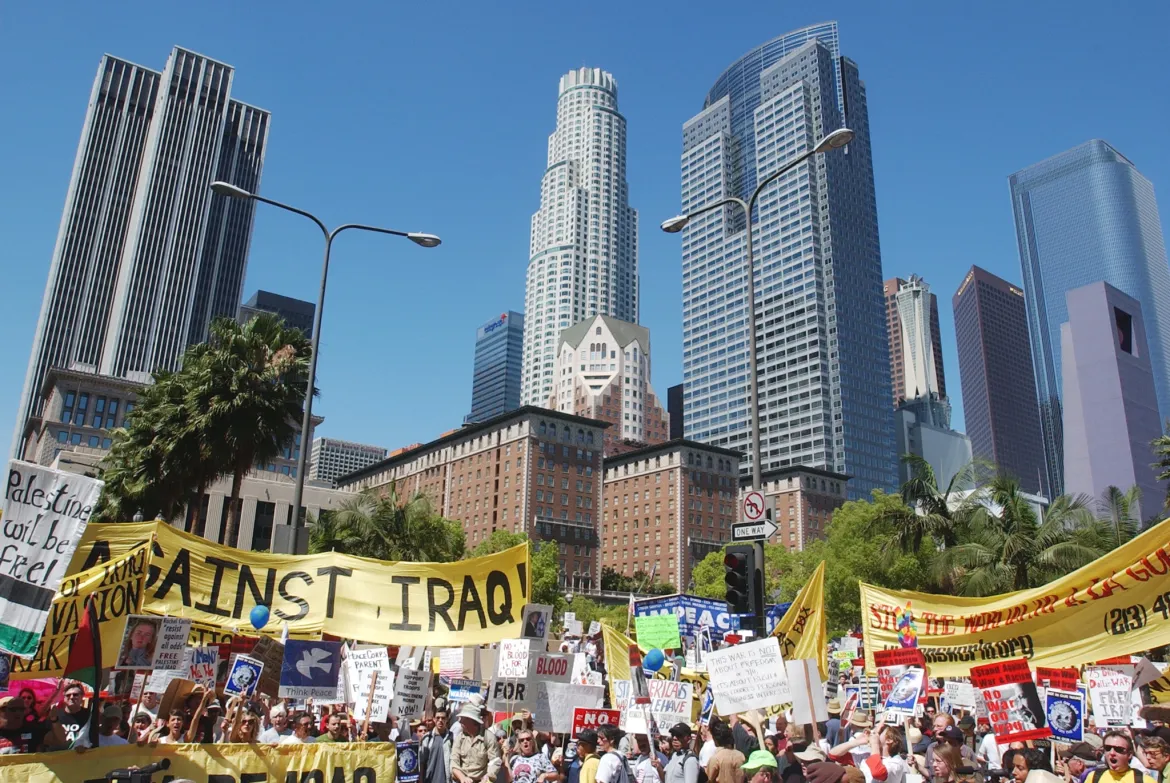
Millions of people around the world protested U.S. war plans against Iraq. Los Angeles, March 15, 2003.
Twenty-five years ago, on the morning of Sept. 11, 2001, I had just finished editing an article when I answered a call on the apartment phone from my Workers World Party comrade, Fred Goldstein. To my hello he answered: “You work at the World Trade Center, don’t you? You’re still home. Good.”
“Yes, why — did someone blow it up?” I replied, because someone bombed Tower 1 of the WTC in 1993. When my employer moved there in 1998, even the wide-screen view of New York Harbor from the 78th floor cafeteria was little solace.
Repeating the news report, Goldstein told me a commuter plane flew into WT1. Damn, I thought.
It was a beautiful clear early September Tuesday. Instead of leaving early to walk the three miles along the Hudson River to the office, I had stayed home to finish editing. I had been a managing editor of Workers World since 1982. Since I stayed in the insurance office until 9 p.m. Monday night to wait out a rainstorm, I figured they owed me a few hours.
Our department was on the 31st floor. Work’s official starting time was 8:45 a.m., thus I officially should have been there when the airliner struck the 96th floor of WT1 at 8:46 a.m.
No one answered at the office
I called my supervisor to ask if I should come in, but neither she nor anyone else answered. I started calling my mother, brother, son and sister to assure them that I was home safe. I’d never reach my spouse at the hospital or my daughter at the school where she taught. Radio news then reported that a second plane had crashed into Tower 2 and a third into the Pentagon. Later, a fourth plane crashed in a rural field in Pennsylvania. S–t!
Immediately I realized that this was no accident and that the George W. Bush administration would exploit the attacks as a pretext for going to war. That’s the inevitable thought from 38 years of experience in a Marxist party and a thought to act on.
I phoned our editor-in-chief, Deirdre Griswold, and said we need to call a meeting to change the content of the next issue and figure out what to do next. She agreed.
Walking east on 25th Street toward that meeting at just before 10:00 a.m., as I neared Eighth Avenue, I heard a collective moan from the endless line of downtown workers streaming uptown. WT2, the South Tower, had collapsed.
Official reports say about 3,000 people died in the attacks that day. That included about 265 passengers on four planes, and 350 firefighters and 60-70 police in the two WTC buildings when they collapsed. Also 125 at the Pentagon and another approximately 800 people in or around WT2 and 1,600 in or around WT1. Most WTC deaths were among people on the floors above the ones where the planes hit.
For comparison, during the spring of 1999, U.S. bombs and rockets hit hundreds of civilian targets in the former Yugoslavia, striking schools, hospitals, bridges and a small city east of Belgrade, Pancevo, that was Serbia’s center of chemical manufacturing. Earlier, in Korea and Vietnam, or later, in Iraq, U.S. bombs killed millions of civilians.
For the U.S. population, however, an attack from “abroad” was a kick in the gut. The 9/11 casualties created an opportunity for the Bush administration to wage a war of aggression with initial popular support. Televising endlessly the buildings collapsing spread the trauma across the country.
The insurance company paid us all for a few weeks while management searched for an office to work out of. I went on editing and organizing. They were offered space in Newark, New Jersey, and I restarted work in October amid a crisis that was both personal and political.
Trauma at the office
About 1,800 people were employed at the health insurance company. Of those, roughly half had arrived at the office when it happened. Thirteen died, only one of whom I knew by name. I had to submit data to him every three months.
Three of my colleagues who had been at work that morning had to flee down 31 flights of smoky stairs, their faces covered by silk scarves.
One of my closest colleagues was standing outside, looking up at the fire in Tower 1, when the second plane struck Tower 2. Standing next to him was a woman who was struck and killed by a falling wheel from the plane. He had to jump over her body to escape. The memory was too much for him and he resigned soon after we resumed work.
Another co-worker, who I later found out was working on a project to replace me, fell ill and never returned. Management fired two departmental secretarial workers, whose major tasks had been replaced by word processors. Here too, the bosses could use the disaster as a pretext. The class struggle continued.
Despite these firings, someone in management told me that the standard operating procedure following a disaster is to rebuild everything as it had been done before, not to shift to something untested. For me that meant reprogramming the application I was responsible for so that it could function on phone lines with poor connectivity wherever we wound up.
I also learned that by talking to people who have been through a horrible experience, you can get a sort of induced traumatic experience. And since my co-workers needed me to finish my part of the job before they could return to their normal daily work, which they really wanted to do, I started working hard.
Except for the big boss of our department, I was the first person in the office in the morning and the last to leave for six days in each of the 10 weeks we were guests in Newark. Meanwhile, management searched for a home in New York City. Work atmosphere returned to normal, except after a plane crashed in the Rockaways and retraumatized the office and once when a sonic boom broke a window in the hallway.
Imperialist war
Everything changed politically after Sept. 11, 2001. And it changed just as we at WW anticipated.
Vice President Dick Cheney seized the White House bunker and started plotting the next wars before Bush Jr. could get off Air Force 1. His collaborators were neocon guru Deputy Secretary of Defense Paul Wolfowitz and Secretary of Defense Donald Rumsfeld, a promoter of “shock and awe” −− that is, using a devastating rocket and bomb attack to stun Iraq’s population and military into surrendering.
They plotted and ordered invasions of Afghanistan on Oct. 7, 2001, and Iraq in March 2003. Like today’s MAGA regime, the Bush gang made personal gain from its wars, but were quieter about it. They were more concerned with disguising these wars as having a higher purpose –– fighting “terror.” Members of the Bush cabinet, such as Treasury Secretary Paul O’Neill and White House Chief Terrorism Adviser Richard Clarke, have written books revealing these plots.
In the buildup to the invasion of Iraq, Bush and Secretary of State Colin Powell lied to the public hundreds of times about the phony “weapons of mass destruction.” All of this is documented.
The Cheney cabal was attempting to reconquer those parts of the world that had gained at least some independence during the time the Soviet Union’s mere existence strengthened the position of the former colonies. In 2001, the USSR had disappeared, Russia was weak, and China had not yet become a rapidly rising economic rival to the U.S.
The ruling powers inside the U.S. and their media stood behind the war plans 100%, and very few voices within the Bush administration or among elected officials spoke out against it. The ruling class was unanimously pro-war.
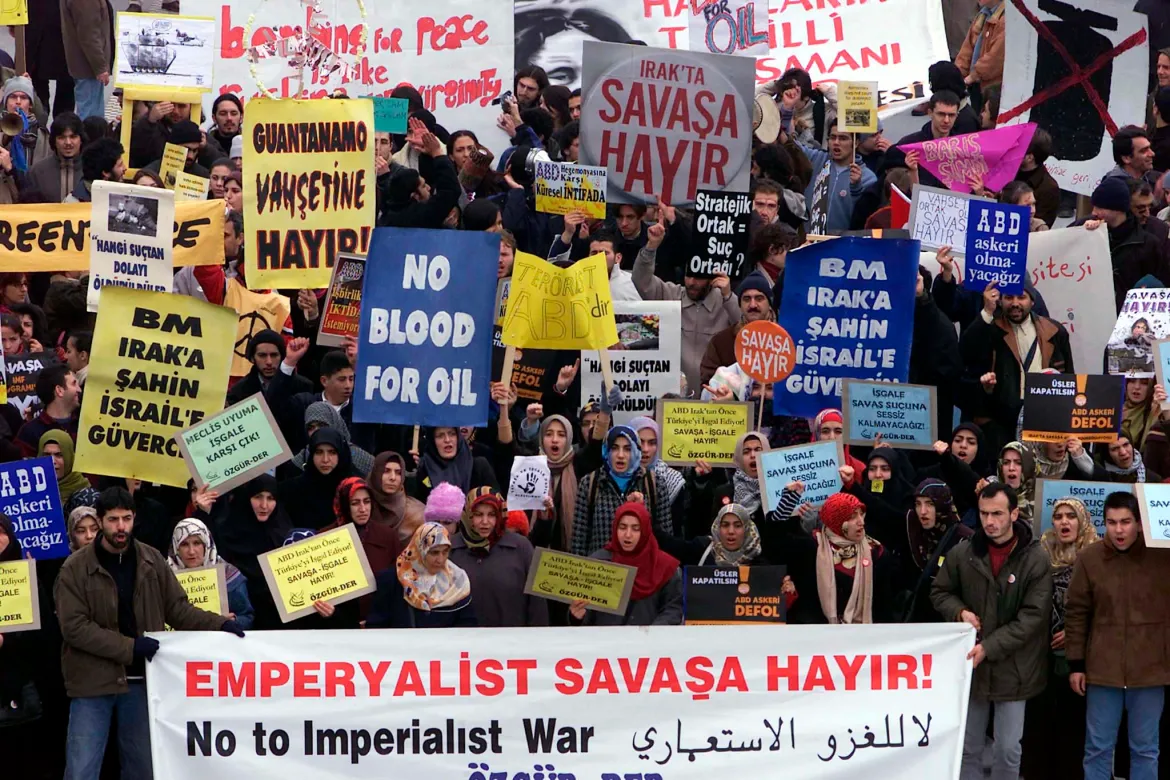
Istanbul, March 15, 2003.
Mass antiwar feeling remained strong
Despite the war fever after 9/11, it was possible at the time to mobilize people against war. It was people on the left, anti-imperialist wing of the progressive movement, along with pacifists and those associated with progressive churches, who came together to protest in September and October 2001.
There were nightly vigils in New York. Even relatives of 9/11 victims protested the government’s use of those victims to justify the war. One relative was the sister of someone at the company I worked for who couldn’t walk to escape.
In late September, an important event for WWP and for the antiwar movement took place. There was a demonstration planned for Washington, D.C., organized by a broad coalition to oppose the reactionary aspects of globalization. Some of the groups in the coalition, mainly the social-democratic ones that oriented toward reformism and working with elements in the Democratic Party, pulled out of the Washington demonstration following the 9/11 attacks and the regime’s threats.
The groups WWP worked with, like the International Action Center, picked up the challenge and proceeded with the demonstration. On Sept. 29, some 7,000 people said no to the war against Afghanistan and opposed using the 9/11 attacks as a pretext for the militarization of the country and for passing all sorts of “anti-terrorist” measures.
Contrary to what some people expected, it was possible to demonstrate in the streets if you were willing to take the risk of being politically isolated. The conditions offered more determined anti-imperialist groups — such as the International Action Center and the new coalition we called International ANSWER (Act Now to Stop War and End Racism) — a space to provide guidance to those who were seriously asking, “What did the U.S. do that made us the target?”
As a result of WWP’s boldness that September and the party activists’ experience in organizing, for over two years an organization with an anti-imperialist and internationalist outlook had a leading organizational role in mass antiwar actions in the U.S.
Over the following 16 months as preparations for the March 2003 invasion of Iraq were underway, the antiwar movement was at its strongest in terms of numbers. The more social-democratic and pacifist groups also organized, and worldwide as many as 10 million people participated in demonstrations in January and February 2003 on all seven continents, including a protest among the scientists in Antarctica.
U.S. imperialism launched the war anyway. It caused enormous pain for Iraq — but the U.S. was unable to completely conquer the country — and in Afghanistan, which the U.S. military retreated from in 2021.
That’s what I’ll be thinking about who couldn’t walk to escape the 25th anniversary of 9/11. How to stop the next war and do it better.