What the Himalayas glacier avalanche means for us
Around 8:30 a.m. local time on August 26, millions of tons of rock and ice split from high on the Langtang Lirung Glacier near the Nepal-China border. The mixture of glacier, bedrock and mud plunged thousands of feet into the Lhende Khola and Bhote Koshi river valleys picking up speed and debris before creating a temporary dam in the Lhende Khola River.
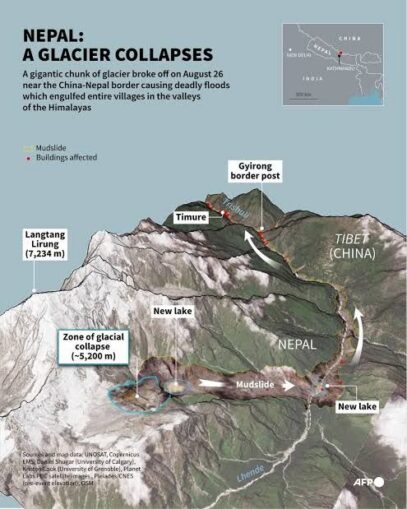
When the dam failed, a massive surge of water, mud, debris and rock nearly 650 feet high rushed downstream into Nepal’s Rasuwa and Nuwakot districts, smashing the road that followed the river, leaving just a trace. It destroyed bridges, houses and hydroelectric projects that were being built in Nepal to supply India and Bangladesh with power, and it obliterated the Gyirong Port border crossing between Nepal and Tibet.
Nepal has a flash flood warning system that sent three-quarters of a million messages to people in the river valley, but this flood outran the warnings. It is possible that thousands of people have died, as many are still missing. Bodies have been pulled out of the river 150 miles downstream, some too mangled to be readily identified. Official casualty figures have been sharply fluctuating.
There were also hundreds of casualties on the Chinese side of the border.
Nearly two weeks after the flood workers are still being saved from the tunnels of the hydroelectric projects.
The first description of this avalanche attributed it to an earthquake. But the U.S. Geological Survey later said it was not. Seismic sensors registered the collapse of hundreds of tons of rock and ice as a 5.2 seismic event, but no tectonic shifts or fault slips — characteristics of earthquakes — were evident.
While the exact cause of this disastrous flood is still not clear, it was not caused by heavy rainfall. The collapse involved an 1,800-foot-wide section of glacier and its underlying bedrock breaking off and falling about 10,000 feet.
How does burning fossil fuels affect glaciers?
Two pollutants that contribute the most to global warming are black carbon, also known as soot, and methane gas. Both of these are short-lived but extremely potent.
Black carbon is a component of fine particulate air pollution and is a direct result of burning fossil fuels, wood and other waste. It absorbs sunlight and converts it directly into heat. This is a major problem when black carbon falls on highly reflective surfaces like snow and ice.
While the exact cause of the catastrophic detachment of ice from Langtang Lirung is yet to be determined, scientists have been warning of the increasing risk of catastrophic glacier failures and deadly floods downstream due to air pollution and global warming. The once white surfaces of the Himalayan glaciers are increasingly receiving the soot from fossil fuel pollution and becoming coated with it. (New York Times, Sept. 2, 2026)
When these surfaces are white, they reflect up to 90% of the energy striking them from the sun — this is a high albedo. When the same surfaces have a coating of black carbon, they might only reflect 40% of this energy, leaving a dark surface that absorbs a lot of the heat. The resultant warming causes glaciers to become porous, allowing melt water to permeate them, risking glacier failures and floods.
Glaciers are not stationary, and all move at different rates. Satellite photos showed that the glaciers high up in the Himalayas had been observed to be moving slowly at least since the beginning of 2026.
The water from melting enables glaciers to move more easily and creates lakes both on the surface and under them. It can cause underlying permafrost to melt and lose cohesion. When this takes place on steep mountainsides, huge chunks of the glaciers and rock can break off, causing deadly landslides and avalanches, as probably happened on Langtang Lirung.
The policy of the Trump administration on global warming
While black carbon does not persist very long in the atmosphere, it is very potent. It is also a contributor to pollution that is harmful to breathe, as well as a major contributing factor to environmental disasters. It is produced by incomplete burning of fossil fuels like coal, gasoline and diesel.
Trump’s determination to increase the use of fossil fuels directly contributes to this dangerous pollutant. According to Trump, “global warming” is a “con job.” He demands nations buy “more U.S. oil and gas,” declaring falsely that fossil fuels are cheaper and much more reliable than renewable energy sources. (Trump speech to United Nations General Assembly, Sept. 23, 2025)
Climate change and global warming are the complicated results of many factors. It is admittedly going to be very difficult to remove heat trapping gases from the atmosphere. But the campaign to increase the pollutants resulting from fossil fuel use further sabotages the goal of limiting, let alone reversing, the accelerating warming of the earth’s atmosphere.
Those who are working to alleviate climate change must continue to demand that immediate steps be taken to reverse these policies and to rapidly and vastly increase reliance on cleaner energy. The efforts being made by China and other countries serve as examples of policies that can begin to mitigate the destruction the world faces due to global warming.