Richard Wright Birthday Bulletin 2026
The author wrote the following to mark September 4 — the 118th birthday of Richard Wright — in the context of efforts to bring back McCarthyism in 2026.
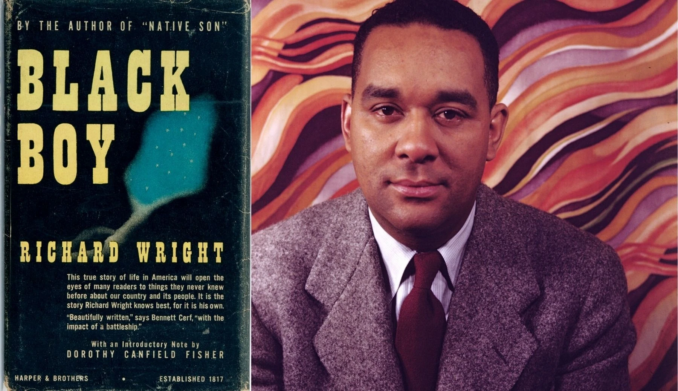
In the Dec. 31, 2025, Richard News Bulletin called “Eras of silence: Re-reading ‘Black Boy’at 80,” I wrote about the absence of commemoration of the 80 years of “Black Boy,” likening the silence around my father’s memoir to the silence that pervades the first few chapters of his book.
The hushed tones in the home, the failure to give the children words for the horror of the lynching that took their uncle from their midst, that key question from Richard, “Why did we not fight back?” suppressed by a mother whose fear “slapped him into silence” …
I left it at that.
Then six months later, re-reading the previous Bulletin, I realized that I sent you a nostalgic Blues and that the present Bulletin would have to break the silence with the anger of spoken word.
Before he died, my father encouraged me to be a journalist.
Today as a weathered one, I have learned that an article on an event has no value unless it is grounded in timing and context.
So, what is the event here?
Richard Wright’s birthday
September 4 is the 118th birthday of Richard Wright — an event which unlike his recent birthdays will be celebrated and not silenced thanks to the Richard Wright Society. (See details of the Celebration of his Haiku on Sept. 4 at the Tea Gardens of San Diego at tinyurl.com/57bs8zkb.)
I will open up the celebration to further break silence by letting the haiku speak for themselves — the very haiku his publishers had declined to publish in 1960 in the spirit of the McCarthyism impacting all his submissions — the pretext given was that these poems today internationally acclaimed were “too monotonous.”
My mother, Ellen Wright, published the haiku posthumously in 1998 — 38 years after Richard received the rejection letter. He died four months later.
So, what is the timing and context of this commemoration?
Since I sent you the last Bulletin at least three key documents have come out, documents governing our daily lives, our daily thoughts, our creativity, the books we are influenced to read or not to read, the folks we are no longer free to associate with.
We are to all intents and purposes in “another world.”
Return to McCarthyism?
The first document whose full text is classified and whose guidelines can be found on the White House website is NSPM-7 that writes in stone if not in law the arbitrary criminalization of thought and group association under the name of “domestic terrorism.”
The second document is [Secretary of State] Marco Rubio’s report on “Cuba as the capital of 21st century communism” — a document reinstating de facto a second wave of the McCarthyism Richard Wright among others lived, wrote and died under.
The third document is the Guardian letter whose overt aim was to protect under the manicured umbrella of a cohort of respectable left-wing academics the notion that American’s invasion of Iran with the strongest military in the world can be equated with the government of Iran’s internal, coercive practices even as it is under a violent siege threatening its sovereignty. The underlying aim being, many suspect, to divide the American left and create more consensus for a war whose popularity is fast plummeting in the polls and in world opinion.
This threefold context — preceded by many red flags such as the Palantir Manifesto and the Canary Mission lists to name only two of them — weighs heavily on how we perceive the Black, Asian and Indigenous literary and artistic landscape of which Richard Wright’s books are such an abiding part.
Just as the visible part of the iceberg can be defined by the documents mentioned above, there is the less visible part of the context that prepared the terrain for those documents to be effective.
The banning of Wright’s ‘Black Boy’
I had mentioned in the previous Richard Wright Bulletin that “Black Boy” had been one of 14 titles to be banned at Eastport Long Island School in 2025 under the pretext of “obsolescence.”
When pressed further on the meaning of “obsolescence,” the right-wingers on the school board explained that the copies they had seen were in too poor condition, i.e., “falling apart,” to be placed in the students’ hands.
In other words, those pushing for the banning needed to obfuscate the real reason for their objection to the book: that is to say, the lynching of Richard Wright’s uncle, Silas Hoskins and the horror of white terror under Jim Crow described in the book had to be seen as no longer belonging to today’s MAGA America — rather as things of the past even as Black folks are still found hanging from trees in Wright’s native Mississippi in 2026, and practically nobody writes about it.
Since the last Bulletin, I stumbled on other under-reported instances of banning or shadow-banning of Richard Wright’s works.
In Hinds County, Mississippi, the Richard Wright Library, shut down since 2020 — purportedly for lack of funds like many other libraries in the state — was recently vandalized and a glass case of Richard Wright artifacts destroyed.
Here the paradox is cruelly ironic: a Native Son of Mississippi who was statistically promised to delinquency took himself up by the bootstraps, taught himself how to read and write and became one of America’s forefront writers — only to leave behind books that are now, over a century after his death, being vandalized by … delinquents.
Also today, Richard Wright’s publishers are challenging a book-banning law affecting Iowa’s public school libraries — which would affect nine titles among which “Native Son” [is one].
This time the pretext is objectionable “sexual content.” (tinyurl.com/273p63yx)
We understand only too well why it is part of the white supremacist and liberal agenda to censor Richard Wright. We would not expect less of them. It goes back a long way to the 1940s, when Theodore Bilbo, a Democratic senator from Mississippi and close to the KKK, would rant and rage on the Senate floor against “Black Boy” for being obscene.
However, at this very time and in the aftermath of the Rubio report, the wave of attacks against Richard Wright and his works does not stop with MAGA and the white supremacists.
Dobular’s disinformation
Recently, twice, on Due Dissidence, Russell Dobular has mentioned Richard Wright with the flippancy of dismissive disinformation. Three weeks ago, he stated to Joel Whitney, a best-selling white specialist on CIA matters, that “Richard Wright worked for the CIA before he quit.”
On Aug. 26, he reiterated his disinformation, adding that his daughter may be upset, but facts are facts.
This stubbornness — in spite of my rebuttals in the comments section and most replies agreeing with me — deserves close attention. One, Richard Wright in the French exile he chose had to submit to humiliating surveillance and invasion of privacy on the part of the State Department and the CIA. He was wiretapped at home.
Thanks to the recently declassified memo written by Arthur Schlesinger on the CIA and delivered to John F. Kennedy shortly before the latter was assassinated, we now know that half of the State Department embassy staff outside the U.S. was CIA, and in Paris it was 60%.
Every time he needed to go to the U.S. embassy to renew his passport, Richard had to swear on his honor that he was not a communist. In fact, although he had left the CPUSA [Communist Party U.S.A.] in 1942, he had remained a Marxist, and his closest friends were “Uncle George” aka George Padmore, a revolutionary Marxist and Pan Africanist, and Ollie Harrington who was still in the CPUSA. Richard stoutly refused to renounce those trusted friendships. The last visitor to his small apartment in Rue Regis was Langston Hugues. I was there.
Two, the McCarthyist playbook made sure that Richard Wright’s books would not sell in the U.S., that his royalties would plummet, reducing my father to writing record sleeves for a French company, getting stipends for articles in the French press, in “Présence Africaine,” in Jean Paul Sartre’s “Les Temps modernes” and accepting funds from the Congress for Cultural Freedom to be able to cover the Bandung Conference on Non Alignment when his U.S. publishers got cold-war-feet and would not offer a sufficient advance. When he found out that the CCF was CIA-funded, he was furious and felt bitterly betrayed. He died with 800 dollars in the bank — between the rock of McCarthyist censorship at home and the hard place of being poor rather than accepting CIA funds abroad.
Three, my question is simply: while I can understand why the right is fighting my father’s books, why does a so-called radical part of the white left feel comfortable joining the right in what amounts to character assassination of a Black Red writer at a time when a second wave of McCarthyism is rearing its head? Or maybe the answer lies in the question?
That being said, the truth about Richard Wright will not come from Ivy league quips or ivory tower podcasts where only white “experts” are invited to pontificate about Black lives.
The truth about Richard Wright will come from the very communities he always wrote for.
From those on death row who, like Bigger [Thomas, the main character in Richard Wright’s Native Son], understood without always finding the words to say it that the only real and just death penalty was for the capitalist system that put them there in the first place.
From those on death row today like Keith LaMar who has always said that “Black Boy” has helped him survive and has created from his cell: “Native Sons – A literacy program for at-risk youth.”
Elaine, Arkansas, youth speak out
From the youth of Elaine, Arkansas, who three years ago collected the memorial soil where Richard’s uncle Silas Hoskins was lynched and who along with their mentor, Dr. Mary Olson, write to me today bearing witness to what they, as young descendants of the survivors of the 1919 Race Massacre, want to do to bring an answer to the question young Richard was slapped into silence for asking: “Why did we not fight back?”
They read Chapter Two of “Black Boy”, describing Elaine as a place of bungalows and an abundance of food, and they are reading the history of their own people as well as that of Richard Wright’s lynched uncle. They now challenge themselves with the question Richard Wright asked his mother in their flight from Elaine to keep from becoming the next to be lynched, “Why did we do nothing?” Today the teens ask themselves, “Are we doing what we can locally and beyond?” A never ending question.
London Magsby, the oldest of the Elaine teens. writes to those at the Richard Wright Library near Jackson: “Please keep the library open for our history. All kids need our history even if they think they don’t. I turned 16 and am still in high school. I take two history classes I chose to take, because I am willing to learn about my history and how things change from centuries to this cruel world of people.” London’s brother, Caleb, writes: “I am sorry to hear what happened. Please keep the library open.”
As Dr. Mary Olson and James White talked with the young people, they were asked, “When will our own Richard Wright Library and Research Center open?” It is being held up, because the building has been donated, but it sits on public school property for which the state says “it can not find a deed.” But it will open soon. The publishers have donated Richard Wright books. Another non-profit has donated a truck load of African American books. It will become part of a much needed movement to protect and save libraries and centers of Black History.
Wright’s haiku on last birthday
Perhaps with this timing and context, we can also understand better my father’s own haiku to himself on his last birthday:
It is September
The month in which I was born
And I have no thoughts
He had continued to write haiku after the rejection of his haiku manuscript and the targeting of thought under McCarthyism; the feeling of being wiped clean of one’s own thoughts is a cry that resonates in today’s AI -dominated society, a society that values thought only as long as it is approved by the state and processed by thought-hungry machines.
(c) Julia Wright, August 31st 2026. All Rights Reserved
____________________________________________________________
Richard Wright’s Words Unhurled: a poem
“I would hurl words into this darkness and wait for an echo, and if an echo sounded, no matter how faintly, I would send other words to tell, to march, to fight, to create a sense of the hunger for life that gnaws in us all.” – Richard Wright
the other day
in air-conditioned solemnity
the question was asked
in a Congress hearing
primed to be historic
whether the practices of MKULTRA
still applied
everybody
hemmed and hawed
and beat about the bush
of a plush carpeted floor
to sort of agree
that it could well be
but nothing was actually specified
meanwhile MKULTRA
is all around us —
in the books we no longer have to read
to join the Ivy League
in chatGPT
and in AI
consulted around the clock
as our new oracle of Delphi
when it is not bombing
booklorn children in Minab
each book we fail to discover
from cover
to
cover
wilts
and its pages
are fallen petals
no season
can bring back
each book we leave to moulder
caged
in a library shutdown
for lack of our tax dollars
may be criminalized as fair prey
for illiterate youth
called vandals
while imperceptibly
the most advanced cells
our brain uses to read
are also left to die —
an invisible lobotomy
stripping us
of our humanity
and
each book cast aside
executes its writer
one more time
be he alive
or an ancestor
whose words helped us thrive
we are a country
approving the death penalty
for books as well as men
for books as well as all sentient beings
for books as well as minds
We refuse to clamor
with the capturing elite:
books are dead.
long live the post literate King
(c) Julia Wright, July 18, 2026. All Rights Reserved to donations for the reinstatement of the Richard Wright Library in Hinds County, Jackson, Mississippi, shut down for lack of funds and several times vandalized from 2020 onwards — a glass case with Richard Wright artifacts having been destroyed. If you want to make a donation however small, even the price of one pencil or ball pen, please email [email protected], and I will place you on a list of donors to be contacted once we have a support group and a fundraising link. If you cannot donate but have an idea about book-rescue, please share.